 by
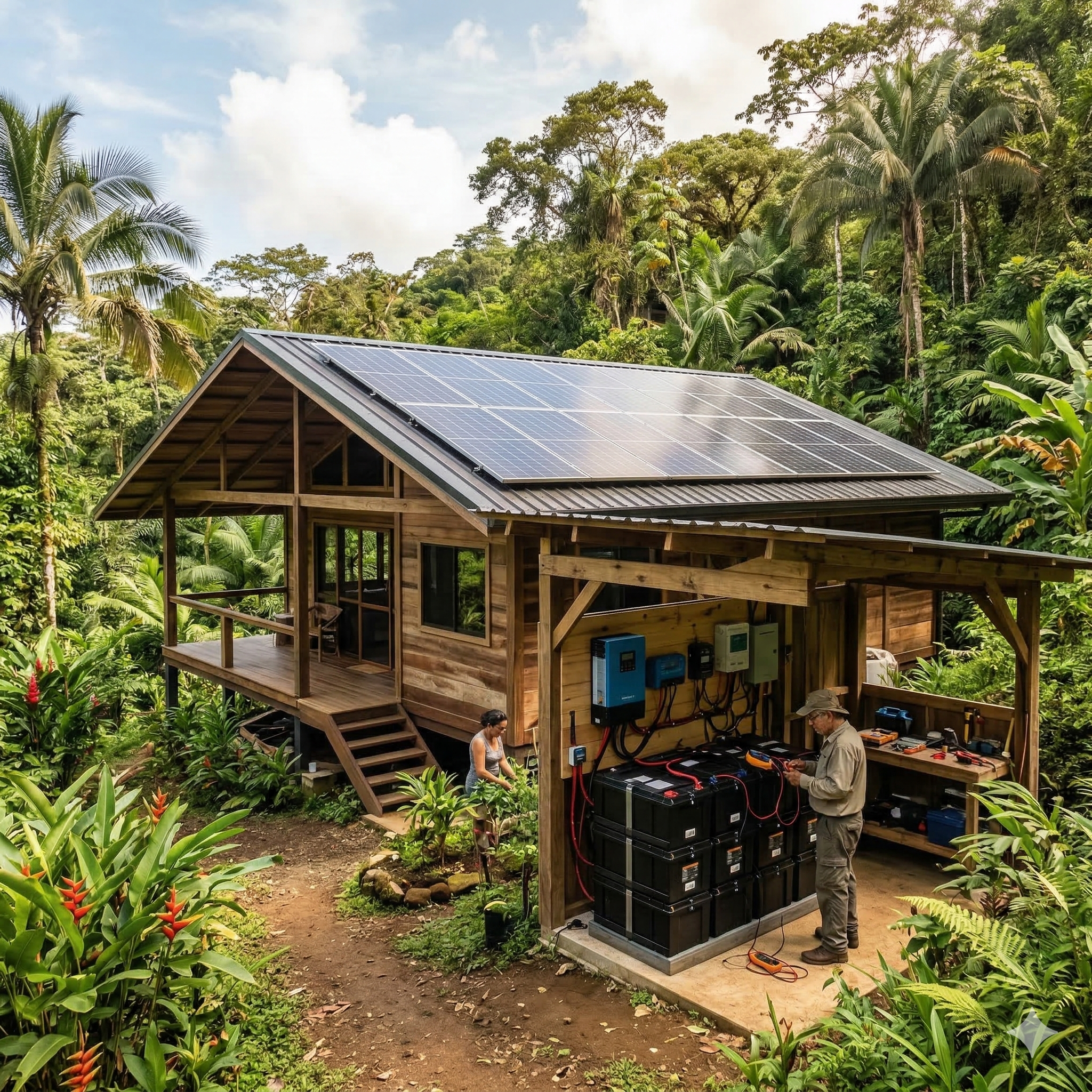
Building Off-Grid in Costa Rica: Solar, Batteries, and the Real Cost Picture
When people picture a home in Costa Rica, they usually imagine the same things: nature, peace, ocean air, mountain views, maybe a little more freedom than they had before. And for many international buyers, that sense of freedom naturally leads to one big idea: living without depending on the electrical grid.
It sounds logical. Costa Rica has sunshine, a strong environmental image, and growing access to solar technology. So why not build a home powered by solar panels, batteries, and a smart inverter system?
Because there is a big difference between the dream of an energy-independent tropical home and the real-world mechanics of making that happen. The challenge is not just producing electricity. The challenge is delivering reliable comfort every single day, even during cloudy stretches, even when the well pump kicks on, even when air conditioning is running in hot, humid weather, and even when friends or family are staying over.
That is where many off-grid projects go wrong. A system that looks fine on paper can become frustrating fast if it was undersized, poorly designed, or based on unrealistic consumption assumptions. On the other hand, when the system is correctly planned, an off-grid home in Costa Rica can work extremely well.
The country offers strong solar potential, and there is a local market of installers working with hybrid inverters, lithium batteries, and larger residential systems. But it is important to stay grounded: off-grid does not automatically mean cheaper. In fact, in many cases it costs more than a grid-tied setup, because you are paying not only for production, but also for energy storage, controls, protections, backup strategy, and a healthy performance margin.
So the real questions are these:
How do you know whether your project is truly realistic?
How much solar capacity do you actually need?
How much battery storage makes sense?
Which local providers should you look at?
And what does it really cost to live off-grid in Costa Rica today?
Let’s break it down clearly, with practical examples, real-world logic, and none of the fluff that often surrounds solar conversations.
Start with the only question that really matters: how much power will your home actually use?
This is the foundation of the entire project. And yet, it is the part many people try to skip.
A lot of off-grid projects begin backward. Someone picks a solar package first, then tries to make the house fit the system. That almost always creates problems.
The right way is the opposite. You do not size an off-grid system based on roof size or a random budget target. You size it based on three things:
Daily energy consumption in kWh
Maximum instantaneous power demand in kW
The level of autonomy you want during bad weather
Daily energy consumption is the total electricity used over a 24-hour period. Instantaneous power demand is different. That is what matters when multiple things start up at once: pumps, compressors, kitchen appliances, laundry equipment, pool systems, workshop tools, and air conditioning.
A house might use only 12 kWh per day, but still require a fairly large inverter because of power spikes.
In Costa Rica, buyers often underestimate consumption. Why? Because many people begin with a simple vision of a tropical home, then gradually add things like:
a pressure pump
a pool
a second refrigerator
several mini-split AC units
a freezer
an electric gate
a security system
outdoor lighting
a laundry area
tools or workshop equipment
a guest casita later on
All of a sudden, the system meant for a modest home is no longer enough.
A useful rough guide looks like this:
Small efficient home: 6 to 10 kWh per day
Comfortable family home: 12 to 20 kWh per day
Villa with AC, pool, or workshop: 20 to 40 kWh per day
Large luxury property: over 40 kWh per day
That alone changes the way you think about the project. But there is another step that matters just as much: separating your loads into what is essential and what is comfort-based.
Typical essential loads include:
lighting
refrigerator
internet
security and cameras
water pump
fans
office equipment
basic outlets
Comfort or discretionary loads often include:
air conditioning
electric water heating
oven
washer and dryer
pool pump
workshop equipment
heavy kitchen appliances
Why does that distinction matter so much? Because a smart off-grid system does not always need to feed every load equally, at every moment, with no strategy. The best systems prioritize. They protect comfort without forcing the owner to pay for a bloated, overbuilt setup.
Let’s say you are planning a 1,900-square-foot home in Guanacaste, Uvita, Nosara, or the inland hills. You estimate the following daily use:
2 refrigerators: 3 kWh/day
LED lighting: 1 kWh/day
internet, cameras, and home office: 1.5 kWh/day
water pumping: 1.5 kWh/day
laundry: 1 kWh/day
light kitchen use: 2 kWh/day
2 mini-splits used moderately: 4 to 6 kWh/day
You are already around 14 to 16 kWh per day, and that is before a pool pump, electric water heater, or guests who leave the AC running all afternoon.
This is why the starting point should always be your actual lifestyle, not the equipment brochure. If you understand how the home will really be used, you avoid the most common off-grid mistake of all: assuming that more batteries can magically compensate for poor planning.
Solar panels, batteries, and inverter sizing: how to build a system that actually works
Once consumption is clear, then it makes sense to talk about components.
An off-grid system has three jobs:
produce enough energy
handle peak loads
store enough reserve for night and poor solar days
That sounds simple. In practice, it is where cost, comfort, and system performance all collide.
Solar array sizing
The solar array must produce enough usable energy not just in ideal conditions, but in real life. That means accounting for heat, inverter losses, battery charging losses, wiring losses, cloud cover, dirt, and seasonal variation.
A practical off-grid rule of thumb is that each 1 kW of solar panels may deliver around 3.5 to 4.5 kWh of usable daily energy in a realistic tropical installation.
Using that logic:
a home using 10 kWh/day often needs about 3 to 4 kW of solar
a home using 15 kWh/day often needs about 4.5 to 6 kW
a home using 25 kWh/day often needs about 7 to 10 kW
a home using 35 kWh/day may need 10 to 14 kW or more
That range may seem larger than expected. But off-grid design should be conservative. A grid-tied home can borrow from the utility when production is low. An off-grid house cannot.
This is especially important in Costa Rica, where annual solar potential is favorable, but local performance still depends on:
roof orientation
shading from trees
coastal salt exposure
cloud patterns
heat
maintenance habits
equipment quality
A beautiful lot surrounded by tropical vegetation may look perfect, but if late-afternoon shading hits your array every day, it changes the numbers.
Battery storage sizing
If solar gets the attention, batteries are what make the system livable.
Today, most serious residential off-grid projects use LiFePO4 lithium batteries, also known as lithium iron phosphate. They are popular because they combine safety, long cycle life, and dependable performance.
Typical storage ranges look something like this:
efficient small home: 10 to 15 kWh
comfortable full-time home: 15 to 30 kWh
villa with AC and pool: 30 to 60 kWh
larger luxury setup: 60 kWh and up
Why so much?
Because batteries do not just “cover the night.” They also provide:
reserve for cloudy weather
better comfort margin
protection against deep discharge
stability during heavy loads
peace of mind for the owner
This is one area where people are often overly optimistic. They think, “We only need enough for nighttime.” But real off-grid life is not a perfect chart. Maybe the previous day was cloudy. Maybe the pump ran longer. Maybe the house had visitors. Maybe several AC units were used at once.
A battery bank that looks adequate in theory can feel small very quickly in real life.
Inverter sizing
The inverter is the quiet hero of the whole system. It is what turns stored DC energy into the AC electricity your home uses. And more importantly, it has to handle startup surges from motors and compressors.
That means a house with moderate daily energy use may still require a larger inverter than expected.
For example, a home using around 15 kWh/day might still need:
8 kVA
10 kVA
or even 12 kVA
depending on what starts simultaneously.
This is where system failures often begin. The battery bank may be large enough, the solar array may be adequate, but the inverter is undersized for real-world behavior. Then the owner starts hearing things like, “Just don’t run that pump while the dryer is on.” That is not what most buyers have in mind when they imagine a comfortable home.
A well-designed system accounts for real usage patterns, not idealized ones. And in Costa Rica, that matters even more because many homes depend on pumps, have remote water systems, and use air conditioning strategically rather than constantly.
The big takeaway here is simple: an off-grid solar system is not just a collection of components. It is a balance between production, storage, and peak power. If one of those three is off, the whole experience suffers.
Local providers in Costa Rica and what you should actually ask them
If you are buying from abroad, the natural instinct is often to look for the best price. That makes sense. But with an off-grid system in Costa Rica, the cheapest quote is rarely the best value.
What really matters is whether the provider can design the system correctly, install it properly, support it later, and troubleshoot it when something goes wrong. This is especially true if your property is:
a long way from town
in a humid region
near the coast
up in the mountains
reached by rough roads
exposed to lightning or tropical storms
In those settings, support matters just as much as hardware.
Costa Rica has a visible solar installation market, including providers working with hybrid systems, batteries, and backup-oriented residential setups. Buyers often come across names such as:
Avolta Energy
IntiTech Solar
Costa Rica Solar Solutions
These kinds of providers typically work with battery storage, larger inverters, and residential energy independence solutions. That does not mean every provider is equal, and it does not mean you should choose based on branding alone. But it does mean there is a local ecosystem to work with.
Questions that matter more than price
Before signing with any installer, ask specific questions. Not vague ones. Not “How many panels do I need?” Ask the questions that reveal whether they truly understand off-grid living.
Ask things like:
What monthly production do you realistically expect at my exact site?
How many hours or days of autonomy will I have in poor weather?
What changes during rainy season?
What happens if my battery state of charge is low at 7:00 PM?
Are you designing with a generator or without one? Why?
Who handles service after installation?
How quickly can someone come on-site if there is a problem?
Which spare parts are stocked locally?
What monitoring platform is included?
How will the system handle future expansion?
What maintenance do you recommend in a coastal environment?
One of the smartest questions you can ask is this:
“What happens if I add a pool, another AC unit, or a guest house two years from now?”
A good installer should have a clear answer. Ideally, they should show you whether the system can be expanded and where the limits are. If they cannot explain that, there is a risk you will end up paying twice.
The danger of buying hardware without integration
Some buyers consider importing components themselves or sourcing equipment internationally. Sometimes that can reduce hardware costs. But an off-grid system is not just a shopping list.
You are not only buying:
solar panels
batteries
and an inverter
You are also buying:
structural mounting
electrical protections
grounding
surge protection
combiner boxes
properly sized cabling
programming
ventilation
backup integration
commissioning
support
This is where many self-sourced systems fall apart. On paper, the parts are excellent. In reality, the system is poorly integrated, badly protected, or hard to service locally.
Why the home design and the energy design should happen together
This is a point many buyers discover too late: the house itself has a huge impact on the energy system.
Things like the following matter a lot:
roof orientation
available panel area
shading from trees
natural ventilation
thermal design
where the equipment room sits
how far the array is from the house
whether pumps need to work harder than necessary
A better-designed house can reduce the size and cost of the off-grid system significantly. That is why the energy conversation should start during site planning, not after the architectural design is already locked in.
In a well-advised real estate process, this is exactly the kind of issue that should come up early. A firm such as Crespo Agency, for example, is well positioned to help buyers think beyond the lot itself and consider how the land, home layout, and energy strategy fit together from the start.
Grid connection or fully off-grid?
Even if your dream is total independence, it is still worth asking one practical question:
How much would it actually cost to bring grid power to the property?
Sometimes full off-grid is clearly the right answer. In other cases, a hybrid system with battery backup may make more financial sense than going fully autonomous. The answer depends on access, utility conditions, and your long-term goals.
This is why the best provider is not simply a panel seller. It is an integrator who can help you compare the true options.
The real cost of going off-grid in 2026
Now we get to the question everybody asks sooner or later: what does this actually cost?
The honest answer is that a comfortable, well-designed off-grid system in Costa Rica usually costs more than buyers expect.
That is not because solar is a bad idea. It is because energy independence is an infrastructure decision, not a decorative upgrade.
What you are really paying for
People often look up component prices online and assume they can estimate the system from that. But the equipment alone is only part of the picture.
Yes, the main hardware matters:
solar panels
batteries
inverter
charge control and switching equipment
But the full installed cost also includes:
import and transport
local logistics
mounting structure
electrical protections
engineering
labor
setup and programming
testing and commissioning
backup integration
monitoring
service access
site-specific installation complexity
That is why the price gap between “hardware cost” and “installed off-grid project cost” can be significant.
Realistic installed budget ranges
The following are not official fixed market prices. They are practical budgeting ranges based on real-world off-grid logic, typical residential configurations, and the level of equipment generally required for dependable performance in Costa Rica.
Small efficient home: 6 to 10 kWh/day
Typical system:
3 to 5 kW of solar
10 to 15 kWh of battery storage
5 to 8 kVA inverter
Likely installed budget:
$12,000 to $20,000
This range works for modest homes with good efficiency, limited AC use, and disciplined load planning.
Comfortable full-time home: 12 to 20 kWh/day
Typical system:
5 to 8 kW of solar
15 to 30 kWh of batteries
8 to 12 kVA inverter
Likely installed budget:
$18,000 to $35,000
This is where many full-time owners land if they want a good standard of comfort without trying to run the home like a luxury resort.
Villa with partial AC, pool, or workshop
Typical system:
8 to 15 kW of solar
30 to 60 kWh of batteries
10 to 15 kVA inverter, sometimes more
Likely installed budget:
$35,000 to $70,000
and sometimes above that, depending on redundancy and finish level
That range surprises people. But once you start combining larger battery banks, stronger inverter capacity, backup planning, and higher-end installation standards, the number rises quickly.
The hidden line item many people forget: backup generator
A lot of buyers initially say they want a 100% solar home with no generator at all. That is understandable. It feels cleaner and more elegant.
But in practice, a well-integrated generator can actually reduce the total cost of the project.
Why?
Because designing a system with no generator at all often means paying for:
more panels
more batteries
more reserve margin
more oversizing for rare weather events
And that extra capacity may only be needed a few days each year.
In many homes, a backup generator used sparingly is a smarter economic choice than a giant battery bank sized for worst-case conditions. That does not make the system less successful. It makes it more realistic.
What about return on investment?
This is where the conversation needs honesty.
For a pure off-grid home, the return on investment is not always the best lens. Why? Because you are not just buying kilowatt-hours. You are buying:
independence
resilience
access to remote land
protection from outages
convenience in places with difficult infrastructure
a certain peace of mind
If your lot would be expensive or slow to connect to the grid, off-grid may make financial sense. If the grid is close and reliable, then a hybrid or grid-tied system might offer a better pure payback.
So yes, costs matter. But the value of an off-grid system is broader than monthly utility savings. Often, the real payoff is that the property becomes practical, comfortable, and usable in a location where conventional utility service would be complicated or fragile.
What a well-built off-grid project actually looks like: real-world style examples
Let’s move from theory to realistic scenarios.
Case 1: the balanced, comfortable home
Imagine a primary residence with:
2 bedrooms plus office
no pool
strong natural ventilation
gas water heating
mixed cooking setup
1 or 2 mini-splits used mostly in the evening
Estimated consumption:
14 kWh/day
roughly 420 kWh/month
A sensible system for this home could be:
5.5 to 6.5 kW solar array
15 to 20 kWh of LiFePO4 batteries
8 kVA inverter
compact backup generator
Why this size?
Because if the house really uses around 14 kWh per day, installing only 4 kW of solar would likely be too tight for a comfortable tropical lifestyle with real margin. You want a home that works smoothly, not a house where you constantly watch the battery screen.
Likely installed budget:
$20,000 to $28,000
This kind of project is often the sweet spot. It gives the owner strong independence, good comfort, and a realistic level of investment.
Case 2: the tropical villa that uses more power than expected
Now imagine a larger villa with:
3 bedrooms
pool
water pumping system
full laundry
home office
3 to 4 AC units
partial electric cooking
regular guests
Estimated consumption:
28 to 35 kWh/day
around 840 to 1,050 kWh/month
At this level, the system starts looking much more serious.
A realistic setup may include:
10 to 12 kW of solar
30 to 40 kWh of batteries
12 to 15 kVA inverter
smart load controls
backup generator
Likely installed budget:
$38,000 to $55,000
And this is the moment many buyers realize something important: this is no longer a “solar add-on.” It is a private energy infrastructure system.
Case 3: the premium owner who does not want compromises
You may already recognize this profile.
The owner wants to:
live just like they would in a fully serviced urban home
run multiple AC zones
host family and friends freely
power a pool, pumps, appliances, entertainment, and workspace
stop thinking about energy altogether
Is it possible? Yes.
But the budget follows the expectation.
This kind of property may move toward:
15 to 20 kW of solar or more
40 to 80 kWh of battery storage
stronger or redundant inverter architecture
a well-integrated generator backup strategy
Likely budget:
$60,000 and up
At that level, comfort can be excellent. But the project has to be treated with the seriousness of a custom system, not a standardized package.
The mistakes that blow up the budget
Across all these scenarios, the same three costly errors appear again and again:
undersizing the system at the beginning, then trying to fix it later
ignoring peak loads, which leads to an inverter that is too small
refusing any backup generator on principle, even when a generator would be more cost-effective than a massive battery expansion
There is a simple truth here:
A well-designed off-grid system is expensive once. A poorly designed one becomes expensive multiple times.
Conclusion
Building off-grid in Costa Rica is absolutely possible, and for many buyers it can be a fantastic decision. The country has strong solar potential, increasing access to quality equipment, and local professionals capable of delivering solid systems.
But success depends on realism.
Before choosing panels, batteries, or inverter brands, the most important question is still this:
How do you truly want to live in the house?
That answer determines everything else: the solar array size, the battery bank, the inverter capacity, the backup strategy, and the real budget.
The most important thing to remember is this: solar panels are not the hardest part of an off-grid home. Storage, power management, and usage behavior are what determine whether the system feels easy or frustrating.
The best off-grid system is not always the biggest one. It is the one that fits your lifestyle, your property, your comfort expectations, and your tolerance for risk.
In Costa Rica, energy independence is not just a trendy idea. It can be a very practical way to unlock beautiful land, build in remote areas, and create a home that feels more self-reliant and resilient.
But it deserves more than a quick quote or a generic package. It deserves careful planning from day one.