 by
Water & Well Drilling in Costa Rica: What No One Tells You Before Buying Land
Buying land in Costa Rica feels like stepping into a dream.
You picture lush jungle views, ocean sunsets, toucans in the trees, warm breezes all year long. Maybe you’re relocating from the United States, retiring from Europe, or investing from South America. You already see the house in your mind — open floor plan, infinity pool, outdoor kitchen.
But here’s the question most buyers ask too late:
Where is the water coming from?
It sounds simple. It isn’t.
In Costa Rica, water access is not automatically guaranteed — especially if you’re buying rural land, hillside property, or a lot near the coast. There are official concessions, environmental approvals, hydrogeological studies, and in some regions, real water scarcity risks.
If you’re used to turning on a faucet without thinking twice, this may surprise you. In Costa Rica, water is not just a utility — it’s a legal, environmental, and strategic issue.
In this guide, we’re going to talk honestly about:
How water concessions actually work
What an AyA water letter really means
The true cost of drilling a private well
Regions with higher drought risk
Why a hydrogeological study can protect your investment
And how to avoid buying land you can’t legally build on
This conversation alone could save you tens of thousands of dollars — and months of frustration.
Let’s break it down.
Understanding Water Access in Costa Rica: It’s Regulated
In Costa Rica, water generally comes from one of two sources:
Public water connection
Private well
The main national authority overseeing water supply is the Instituto Costarricense de Acueductos y Alcantarillados, commonly known as AyA.
However, AyA does not service the entire country.
In many rural communities, local associations called ASADAS manage the water systems. These are community-run entities that distribute water from local sources.
The Critical Document: Water Availability Letter
If you plan to build on a property, you typically need:
An official water availability letter from AyA or the local ASADA
ORApproved authorization to drill a well
Without one of these, the municipality can deny your construction permit.
Here’s the reality many foreign buyers discover too late:
A property can be legally titled… but still not have legally authorized water access.
Yes, that happens.
Common situations:
The seller says, “Water runs right in front of the property.”
A neighbor has a well, so you assume you can drill one too.
An agent tells you, “It won’t be a problem.”
But unless you see an official document issued by the appropriate authority, nothing is guaranteed.
In some areas, new water connections are temporarily frozen due to capacity issues.
Water verification must happen before you close, not after.
Drilling a Private Well: The Real Costs & Timeline
Many buyers think:
“No public water? I’ll just drill a well.”
It’s possible — but it’s not instant, and it’s not cheap.
Step 1: Hydrogeological Study
Before drilling, you must complete a study approved by SENARA (National Groundwater Service).
This study determines:
Whether an aquifer exists
Estimated depth
Expected yield (flow rate)
Environmental impact
Average cost: $1,500–$3,000 USD.
If the study concludes there’s insufficient water, you will not receive drilling approval.
Step 2: Concession Approval
The water extraction concession must be processed through the Ministerio de Ambiente y Energía (MINAE).
Approval timelines can range from 3 to 9 months, sometimes longer depending on the region.
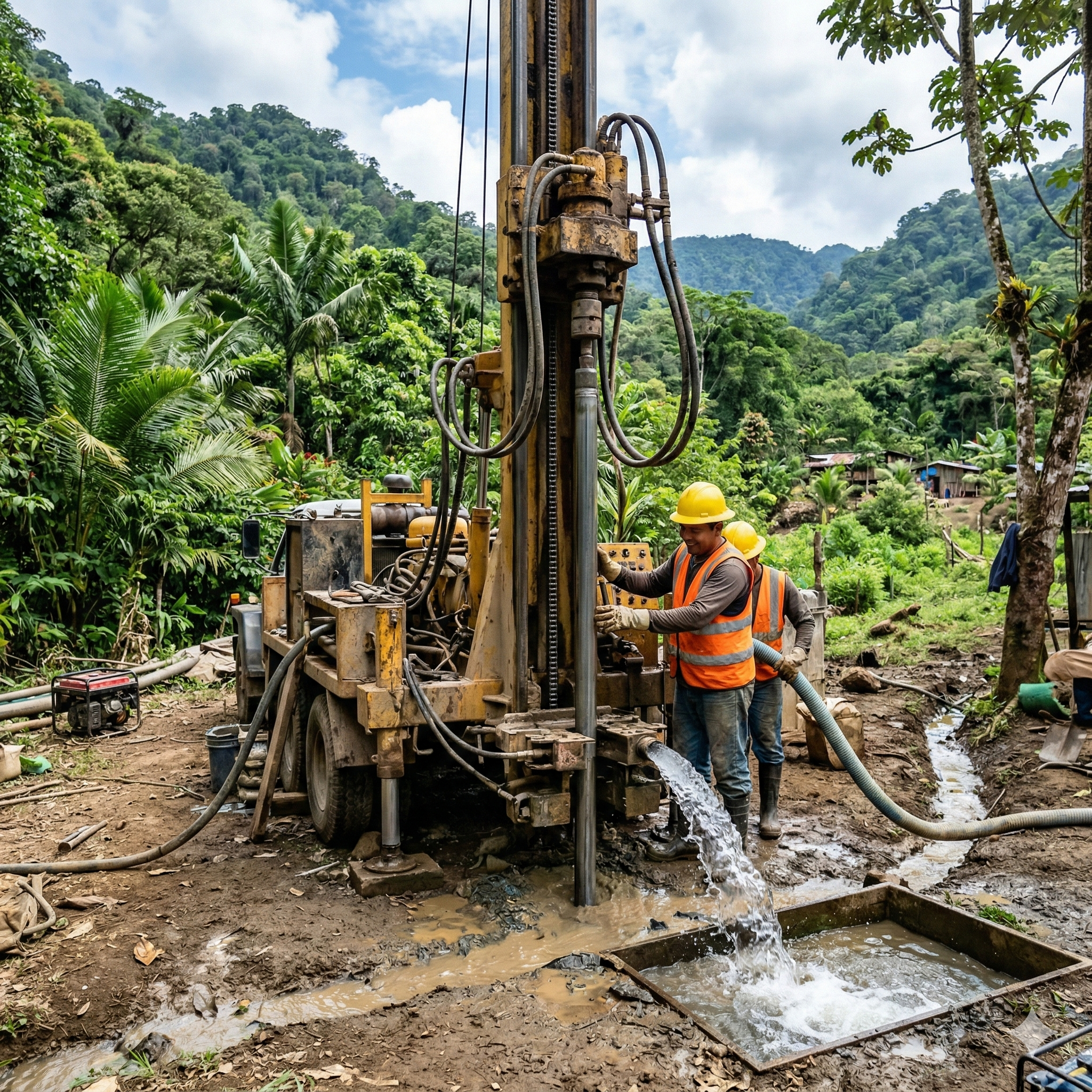
Step 3: The Drilling Itself
Well drilling costs vary depending on:
Depth (commonly 130–400 feet)
Soil and rock conditions
Accessibility of the site
Typical drilling costs:
$15,000–$30,000 USD
But that’s not the full picture.
You must also budget for:
Submersible pump
Electrical installation
Storage tank
Filtration system
Add another $5,000–$10,000 USD.
Total potential investment: up to $40,000 USD.
And here’s the part no one emphasizes enough:
A well is never 100% guaranteed.
Yield may be lower than expected
Production may drop during dry season
Coastal wells may face salinity issues
That’s why proper analysis matters.
Drought Risk Areas: Not All Costa Rica Is the Same
Costa Rica is famous for being green. And it is.
But water distribution varies significantly by region.
The province most affected by seasonal drought is Guanacaste, particularly around the Nicoya Peninsula.
Why Guanacaste?
Dry season can last 5–6 months
Rapid real estate growth
High pressure on coastal aquifers
In certain years, authorities have implemented:
Water use restrictions
Construction limitations
Temporary moratoriums on new water concessions
This does not mean you shouldn’t invest there.
It means you must evaluate water security carefully.
Even in mountainous regions outside Guanacaste, remote lots may lack reliable public access.
The myth that “Costa Rica has unlimited water” is misleading.
Yes, the country has abundant natural resources.
But water use is strictly regulated — and increasingly monitored.
The Hydrogeological Study: Your Invisible Insurance Policy
This is one of the most overlooked steps in the buying process.
A serious hydrogeological study analyzes:
Geological composition
Rock fractures
Aquifer recharge capacity
Contamination risk
For roughly $2,000 USD, you gain technical clarity.
That investment could prevent:
Buying land that cannot support construction
Drilling in the wrong location
Months of bureaucratic delays
Experienced investors never skip this step.
They work with:
A real estate attorney
A licensed hydrogeologist
An experienced real estate agency familiar with rural properties
Some established firms, such as Crespo Agency, integrate water verification into their due diligence process before closing. That level of oversight is especially important if you are purchasing from abroad and cannot personally supervise every detail.
Distance amplifies risk.
Professional guidance reduces it.
Protecting Your Investment: A Practical Checklist
If you want peace of mind, follow this strategy.
Before Signing a Purchase Agreement
Request:
Official water availability letter
Copy of well concession (if one exists)
Registered flow rate
History of local water restrictions
Include a contingency clause tied to verified water access.
If You Plan to Drill
Budget up to $40,000 USD
Account for administrative timelines
Consider temporary water delivery options
Think Long-Term
Ask yourself:
Will the flow support a pool and landscaping?
Could the property be subdivided later?
Will secure water increase resale value?
Water access directly impacts appreciation potential.
Smart Buyer Strategy
Savvy investors typically:
Choose areas with established infrastructure
Require official documentation
Avoid verbal promises
Verify everything before transferring funds
This isn’t paranoia.
It’s smart investing.
Conclusion: Water Determines the True Value of Your Land
When you dream about Costa Rica, you imagine lifestyle — nature, sunshine, slower pace.
But water is the foundation.
Without water:
No building permit
No construction
No long-term value
With verified concession or approved study:
Your project is viable
Your investment is protected
Your resale potential improves
Costa Rica maintains strong environmental regulations — and that’s a good thing. It protects both the resource and your long-term property value.
So the real question isn’t:
“Is the view amazing?”
It’s:
“Is water legally and technically secured?”
Answer that before you buy, and you turn a tropical dream into a solid, sustainable investment.