Introduction
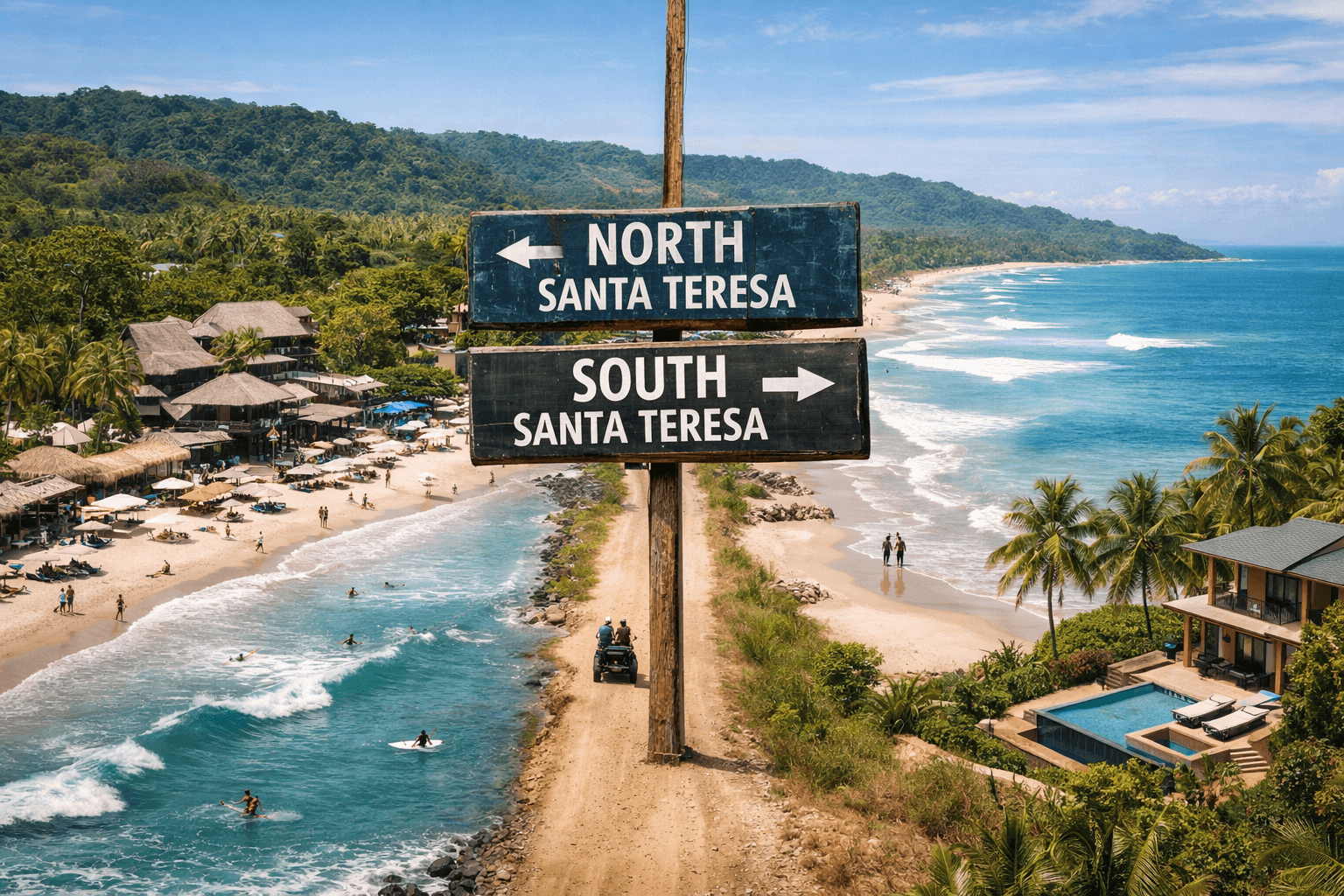
In Santa Teresa, two kilometers can completely redefine a real estate project. Two kilometers that separate two atmospheres, two price dynamics, two ways of living… and two very different investment strategies.
You may have already heard this: “Santa Teresa is small, it’s all basically the same.” In reality, that couldn’t be further from the truth. And in some cases, believing it can be a costly mistake.
Between the North, more developed, accessible and established, and the South, more raw, discreet and evolving fast, the choice is never neutral. It directly affects:
- The purchase price per square meter
- The type of renters or guests you will attract
- The ease of resale
- The real rental returns, not theoretical ones
- Your quality of life if you plan to live on-site
Are you buying to invest? To live part-time? To combine both? Each objective completely changes how these 2 km should be analyzed.
For international buyers — from the US, Europe or Latin America — these nuances are even more critical. What you don’t notice during a short stay can impact years of profitability.
The goal of this guide is simple:
- Give you a clear, honest comparison between Santa Teresa North and South
- Address the real concerns international buyers have
- Help you align your purchase with your true objective, not with an Instagram fantasy
Think of this article as a straightforward conversation. No empty buzzwords. No unrealistic promises. Just the reality on the ground.
Santa Teresa North: the safe, structured and predictable choice
Santa Teresa North is often the first entry point for international buyers. And that’s no coincidence.
A historically more developed area
The North has long concentrated:
- Better road infrastructure
- Higher density of shops and services
- Year-round accessibility
It’s easier to find:
- Well-stocked supermarkets
- Restaurants open all year
- Private and international schools nearby
- Yoga studios, gyms and surf shops
For a first-time buyer in Costa Rica, this is reassuring.
Higher prices… but clearer market logic
Yes, the North is more expensive. But it’s also more predictable.
On average:
- Land prices per m² are higher, especially near the beach
- Turnkey homes are in constant demand
- High-end villas trade year-round
This premium is driven by:
- Consistent demand
- Strong resale liquidity
- The perception of a central, established zone
You pay more upfront, but you reduce overall risk.
Strong and stable rental demand
The North attracts:
- Short-term vacationers
- Digital nomads
- Families on holiday
- Seasonal retirees
Which translates into:
- High occupancy rates
- Easier property management
- Less extreme seasonality
If your priorities are:
- Simple management
- Predictable rental income
- Easy delegation to a property manager
… the North checks many boxes.
The downsides of the North
Let’s be honest.
The North also means:
- More traffic
- More noise in high season
- Less of a “remote paradise” feel
Some buyers, after a few years, start craving more space and tranquility.
That’s often when the South becomes appealing.
Santa Teresa South: nature, discretion and long-term vision
The South offers a different energy. Less immediate. More subtle.
A more preserved, natural environment
In the South, you’ll find:
- Lower construction density
- More vegetation
- Wider, less crowded beaches
It’s the preferred area for those seeking:
- True peace and quiet
- A stronger connection to nature
- A more authentic lifestyle
If you’d rather wake up to howler monkeys than scooters, the South is already speaking to you.
Prices still accessible… for now
The South still offers:
- Attractive land opportunities
- Larger lots
- Lower price per m², especially off the beachfront
But keep in mind:
- The best parcels sell quickly
- Well-accessible areas are becoming scarce
- The price trend is clearly upward
This is a zone best suited for a medium- to long-term strategy.
Rental potential: less volume, more quality
The South targets a different type of guest.
It appeals to:
- Travelers seeking calm and privacy
- Longer stays
- A premium clientele willing to pay for exclusivity
The result:
- Lower turnover
- Higher nightly rates for well-positioned properties
- A more curated rental experience
This is not mass Airbnb. It’s selective, high-value rental.
Why local expertise matters more here
In the South, every property is unique.
Access roads, slope, water supply, electricity, drainage… details that can turn into major issues if overlooked.
That’s why many serious buyers rely on local references such as Crespo Agency, who understand:
- Which micro-areas are truly buildable
- Which lots have the strongest upside
- Which common mistakes foreign buyers tend to make
In the South especially, the right guidance is critical.
Accessibility and infrastructure: the underestimated factor
On a map, North and South Santa Teresa look very close. On the ground, the experience is very different.
Roads and mobility
- The North benefits from better-maintained roads
- The South can become challenging during the rainy season
Practical consequences:
- Harder access for guests
- Higher construction logistics costs
- Faster vehicle wear and tear
Not a deal breaker, but something that must be budgeted realistically.
Water and electricity
Generally speaking, the North is:
- More stable
- Better connected
- Less reliant on alternative systems
In the South:
- Water tanks are common
- Solar energy is often strategic
- Power outages can occur more frequently
For some buyers, this is a constraint. For others, a conscious lifestyle choice.
Internet and remote work
The good news:
- Fiber optic coverage is expanding
- Reliable satellite options exist
Still, the North remains more consistent overall.
If you work remotely full-time, this is a key consideration.
North or South: which strategy fits your profile?
The real question isn’t which area is better.
The real question is: which area is better for you?
You prioritize safety and simplicity
Choose the North if you want:
- Market liquidity
- Predictable rental income
- Easier management
- Smooth resale prospects
This is often the choice of:
- First-time investors
- Retirees
- Buyers purchasing remotely
You seek upside and differentiation
The South makes sense if:
- You think long-term
- You accept gradual appreciation
- You target a premium niche
- You value unique projects
This is the domain of:
- Patient investors
- Entrepreneurial profiles
- Nature lovers
Hybrid lifestyle projects
More and more buyers choose:
- Personal use part of the year
- Rental income the rest of the time
In that case:
- North = immediate comfort
- South = maximum lifestyle quality
It all comes down to your tolerance for unpredictability.
Common mistakes international buyers make
Some pitfalls come up again and again.
Buying based on photos only
Two neighboring lots can have:
- Completely different access conditions
- Opposite legal or technical constraints
Visiting in person or having strong local representation is essential.
Underestimating the rainy season
A perfect road in February may be nearly impassable in September.
Always ask: “What does access look like in October?”
Copying someone else’s strategy
What works for a US investor may not suit a European family or a Latin American buyer.
Your project must reflect your reality, not someone else’s.
Conclusion
Two kilometers may seem insignificant. In Santa Teresa, they change everything.
The North offers structure, predictability and security. The South offers vision, exclusivity and transformation.
There is no right or wrong choice. There is a well-aligned decision… and one that isn’t.
Before deciding, ask yourself the right questions:
- Why am I buying?
- What is my time horizon?
- What level of comfort do I truly need?
Take your time. Get informed. Surround yourself wisely.
Because in Costa Rica — and especially in Santa Teresa — it’s often the invisible details that determine the success of a real estate investment.


Join The Discussion