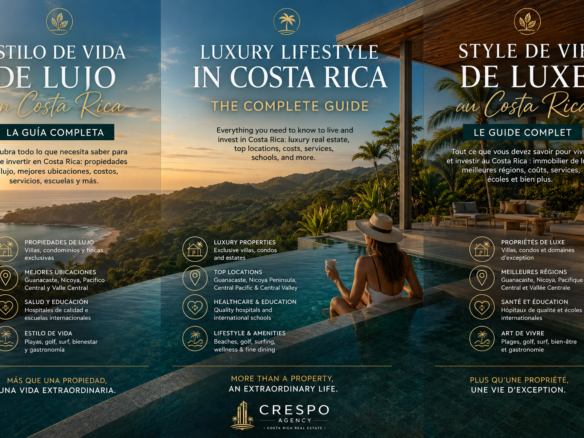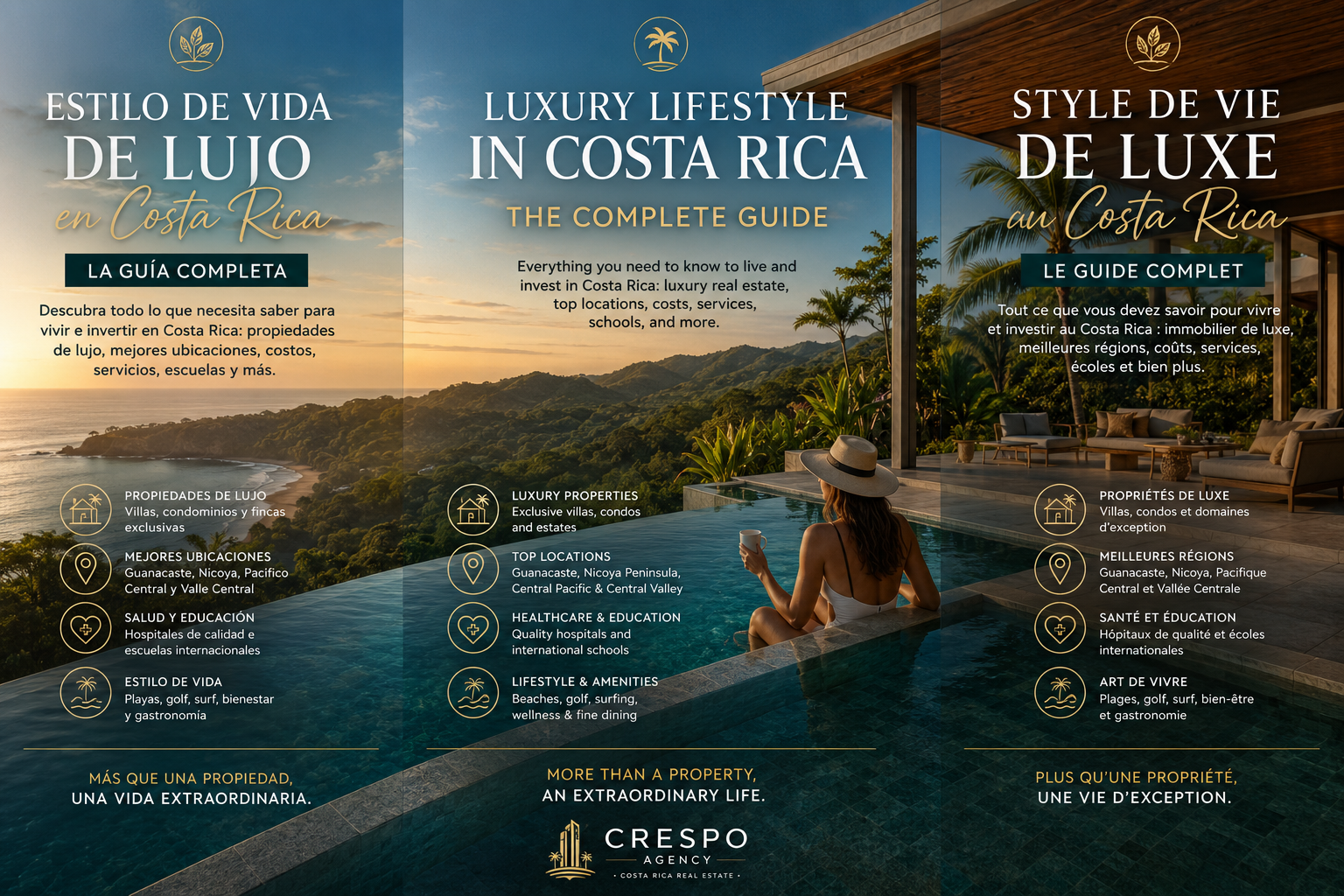
Luxury Lifestyle in Costa Rica: A Complete Guide to Living and Investing in Paradise
Imagine your morning. You open the floor-to-ceiling doors of a contemporary villa overlooking the Pacific Ocean. The temperature is already comfortable, the infinity pool catches the early morning light, and within minutes, you could be walking on an almost untouched beach, working out, or starting your day from a home office surrounded by tropical vegetation.
That lifestyle exists in Costa Rica. But it only tells part of the story.
Because luxury in Costa Rica looks very different from luxury in Miami, Dubai, Monaco, or some exclusive Caribbean destinations. Here, status and extravagance often give way to space, nature, privacy, and something that has become increasingly valuable: time.
An exceptional property might sit at the end of a road surrounded by tropical forest, with uninterrupted ocean views and howler monkeys as neighbors.
That is precisely what attracts international buyers looking for more than a prestigious residence. They are looking for a different way of life.
But behind the postcard-perfect image are some very practical questions. Where should you live? How much should you budget for a high-end villa? Can you access services comparable to those in the United States or Canada? What about healthcare, international schools, security, internet, and maintaining a tropical property? And most importantly, how do you buy confidently without turning your dream move into a complicated process?
Here is what you should know before choosing a luxury lifestyle in Costa Rica.
In Costa Rica, True Luxury Starts With Quality of Life
The first thing to understand is simple: Costa Rican luxury is not measured only by price per square foot.
Yes, Costa Rica now offers spectacular villas, gated communities, infinity pools, architect-designed homes, and residential developments with concierge services, restaurants, golf courses, beach clubs, and private amenities.
But ask someone who has lived here for several years what they value most, and the answer will often be different: space, climate, nature, and the freedom to organize their time differently.
This is where the famous Costa Rican expression Pura Vida begins to make sense.
For a buyer accustomed to life in a major U.S. or Canadian city, the change can be substantial. Your day might begin with surfing or a workout, continue with several hours of remote work, and end with dinner overlooking the Pacific at sunset.
Along the coast, constant access to the outdoors genuinely changes the rhythm of everyday life.
Luxury can take many forms:
- an ocean-view villa with expansive outdoor living areas;
- a pool you can use virtually year-round;
- a beautiful beach just minutes from home;
- regular housekeeping and property maintenance;
- private chefs or in-home catering;
- massages, wellness treatments, and personal training;
- easy access to surfing, golf, sport fishing, or boating;
- greater privacy than many heavily developed beach destinations can offer.
Nature is also part of the experience.
At some properties in Guanacaste or on the Nicoya Peninsula, seeing monkeys, iguanas, parrots, or coatis from your terrace can become part of everyday life. For buyers coming from the United States, Canada, Europe, or South America, this combination of contemporary architecture and tropical surroundings is one of the signatures of Costa Rica’s premium real estate market.
There is, however, one mistake worth avoiding: confusing isolation with luxury.
An extraordinary villa located far from stores, medical facilities, schools, and main roads might feel like paradise for two weeks and become considerably less convenient after six months.
If you are looking for a primary residence, location may ultimately matter more than the house itself.
Guanacaste, Nicoya, the Central Pacific, or Central Valley: Four Versions of Luxury
Where is Costa Rica’s luxury real estate market concentrated?
There is no single answer. Each region offers a different lifestyle and attracts a different type of buyer.
Guanacaste: Ocean Living With a Resort Feel
Guanacaste is one of Costa Rica’s most established high-end real estate markets.
Its relatively dry climate during much of the year, beautiful beaches, established international communities, and convenient access through Liberia’s international airport all contribute to its appeal.
Areas such as Tamarindo, Playa Langosta, Hacienda Pinilla, Playa Flamingo, Reserva Conchal, and Papagayo feature some of the country’s most developed premium real estate offerings.
Here you will find contemporary ocean-view villas, luxury condos, homes within private communities, and residences with amenities comparable to those found at upscale resorts.
In the most desirable locations, a premium property can quickly exceed $1 million, while truly exceptional villas can reach several million dollars.
But two properties listed at the same price can offer completely different living experiences.
Ocean views, beach access, road conditions, security, water availability, community amenities, and proximity to restaurants and everyday services should all be carefully evaluated.
The Nicoya Peninsula: Barefoot Luxury and Wellness
Farther south, destinations such as Nosara and Santa Teresa represent a different interpretation of luxury.
The atmosphere here is less focused on the traditional resort experience and more closely connected to surfing, yoga, wellness, food, nature, and understated sophistication.
The term barefoot luxury describes it well.
A multimillion-dollar home may sit surrounded by tropical vegetation, close to an unpaved road and only minutes from a spectacular, relatively undeveloped beach.
Some buyers are surprised by the contrast.
Others fall in love with the area precisely because of it.
Nosara has developed a strong identity around nature, wellness, and its established international community. Environmental protections and lower-density development in certain areas help preserve the feeling of being immersed in nature.
Santa Teresa, meanwhile, attracts entrepreneurs, investors, families, and globally mobile professionals who want to combine tropical living with international business and an active social scene.
The Central Pacific: Dramatic Nature With Strategic Access
Areas such as Manuel Antonio, Jacó, Herradura, and Los Sueños offer another option.
One of the Central Pacific’s major advantages is its relatively convenient connection to the Central Valley and San José. For buyers who want coastal living without being too far from the capital’s services, this location can make a great deal of sense.
Los Sueños stands out for its combination of luxury residential living, marina access, sport fishing, and golf, while Manuel Antonio is known for dramatic landscapes, ocean views, and tropical rainforest.
Central Valley: Luxury Built Around Everyday Convenience
Not everyone wants to live barefoot by the beach.
Escazú, Santa Ana, and select areas west of San José attract executives, entrepreneurs, diplomats, international families, and retirees who prefer a more urban lifestyle.
Luxury here looks different: secure condominiums, large private homes, upscale restaurants, premium shopping, private hospitals, international schools, and easier access to professional services.
For a family with children or someone who requires regular access to specialized medical care, these conveniences may matter far more than a dramatic Pacific Ocean view.
How Much Does a Luxury Lifestyle in Costa Rica Really Cost?
This is where expectations sometimes need to be adjusted.
Costa Rica is no longer a destination where international buyers can automatically assume everything will cost a fraction of what they would pay in the United States, Canada, or Europe.
In premium areas, real estate, imported vehicles, certain groceries, and specialized services can represent significant expenses.
The range of luxury real estate prices is particularly broad.
Depending on the area and property, an upscale residence may start in the several-hundred-thousand-dollar range. Properties with exceptional locations, strong architectural design, and ocean views, however, can easily exceed $1 million.
In Costa Rica’s most exclusive micro-markets, multimillion-dollar homes are no longer unusual.
But the purchase price is only the beginning.
A realistic ownership budget should also account for:
- pool maintenance;
- landscaping and gardening;
- housekeeping;
- air conditioning and electricity;
- security systems or personnel;
- insurance;
- HOA or community fees;
- vehicle expenses;
- repairs associated with the tropical climate;
- property management if you spend significant time outside Costa Rica.
A large tropical home generally requires more attention than an urban condo.
Humidity, salt air near the coast, intense sun, heavy rain, and fast-growing vegetation constantly test buildings and materials.
A spectacular villa that was poorly designed or constructed can become surprisingly expensive to maintain.
Before buying, look beyond the visible finishes. Ventilation, drainage, roofing, windows and doors, air-conditioning systems, material quality, moisture control, and reliable water access are all critical considerations.
What about household staff?
Cleaning, gardening, maintenance, and other household services can generally be more affordable than comparable services in many major North American cities. As a result, owners can often incorporate regular household assistance into their lifestyle without reaching the costs associated with major U.S. metropolitan areas.
Imported products are another matter.
If your definition of luxury depends heavily on European vehicles, imported appliances, specialty foods, or specific international brands, leave room in your budget.
The best Costa Rican luxury lifestyle often comes from taking advantage of what the country naturally does exceptionally well rather than trying to recreate Miami, Los Angeles, or New York in the tropics.
Buying a Luxury Villa: The Real Work Starts Before the Showing
A spectacular view can make you forget a lot of things.
That is exactly the problem.
At Crespo Agency, we regularly work with international buyers who arrive with a shortlist of properties they discovered from abroad. The photography is beautiful. The infinity pools look perfect. The ocean views are incredible.
Our first conversation, however, rarely starts with interior design.
We first want to understand how the buyer actually wants to live.
Consider an anonymized example of a couple planning to relocate to Costa Rica with their children. Their original goal was to purchase a large, secluded ocean-view villa.
On paper, it sounded perfect.
During our conversations, other priorities emerged: an international school, sports activities for the children, reasonable access to quality medical care, enough room for visiting relatives, and frequent international travel.
Their number-one requirement was not really the view.
It was accessibility.
This approach helps prevent one of the most expensive mistakes in the premium market: buying an extraordinary vacation property that does not work well as a full-time home.
Before purchasing, several areas should be carefully reviewed.
These typically include:
- property title;
- potential easements;
- registered property boundaries;
- building rules and permits;
- availability and legal status of water access;
- road access;
- the property’s tax situation;
- the legal structure used to hold the property;
- special regulations affecting certain coastal properties;
- HOA or private-community restrictions.
Foreign buyers can own real estate in Costa Rica in many circumstances. However, certain properties close to the coastline may fall within the Maritime Terrestrial Zone, or Zona Marítimo Terrestre, where the legal framework differs from conventional titled property.
That is not a minor administrative detail.
When you are investing hundreds of thousands or several million dollars, you need to know exactly what you are buying, under which legal framework, and what rights come with it.
This is why working with qualified local professionals — including attorneys, notaries, and technical specialists when necessary — is essential.
The objective is not to add unnecessary complexity to the transaction. It is to prevent a legal or technical surprise from appearing after the deal has closed.
Healthcare, International Schools, and Security: The Luxury You Don’t See in Listing Photos
A successful relocation is rarely decided by an infinity pool alone.
After the first few weeks, much more practical questions begin to matter.
What happens if you need a medical specialist? Where will your children go to school? Can you leave your property unattended for several months? How long does it actually take to reach an international airport?
Costa Rica has a public healthcare system operated by the Costa Rican Social Security Fund, known locally as the CCSS or Caja, as well as a private healthcare sector used by many international residents.
In the Central Valley, access to major private hospitals and specialists is naturally more extensive. Healthcare options along the coast continue to develop, but anyone with specific medical requirements should carefully consider travel times and proximity to appropriate facilities.
Depending on their personal circumstances, some international residents also choose private or international health insurance.
Education requires similar planning.
Costa Rica has private and international schools, particularly in the Central Valley and in several coastal communities with established international populations. However, the range of programs varies significantly by location.
If you are relocating with children, consider choosing the school before choosing the house, or at least evaluating both decisions at the same time.
A commute that looks reasonable on a map may feel very different when you have to drive it every morning and afternoon, particularly during the rainy season.
Security also deserves a practical, location-specific approach.
As in any country, a high-value property requires measures appropriate to its location and design. Gated communities, controlled access, alarms, cameras, security personnel, and professional home management during extended absences are common within the premium segment.
A secluded villa on several acres should not be managed the same way as a gated condo in Escazú.
There is another invisible amenity that has become part of modern luxury: reliable internet.
For entrepreneurs, executives, and remote professionals, a stable connection with a reliable backup solution may be more valuable than an additional guest bedroom.
During a property showing, do not only ask, “How fast is the internet?”
Ask, “What happens when that connection goes down?”
That is the kind of detail that separates a beautiful house from a home that genuinely supports your lifestyle.
Fine Dining, Golf, Surfing, and Wellness: What Premium Living Actually Looks Like
One of the greatest advantages of the luxury lifestyle in Costa Rica is that you do not necessarily have to choose between comfort and outdoor living.
On the Pacific coast, a single week might include surfing, boating, sport fishing, golf, hiking, horseback riding, yoga, and upscale dining without requiring extensive travel.
Wellness has become an especially significant part of the lifestyle.
Nosara and Santa Teresa have developed strong cultures around yoga, fitness, nutrition, and personal well-being. Private retreats, trainers, massages, in-home treatments, and personal chefs all form part of the ecosystem.
For some buyers, that is simply a nice bonus.
For others, it is one of the primary reasons they choose Costa Rica.
The country is also appealing to people who value fresh food.
Tropical fruit, seafood, coffee, vegetables, and locally produced ingredients make it possible to build a lifestyle closely connected to fresh, regional products.
At the same time, the dining scene has become increasingly sophisticated in several international destinations. Tamarindo, Nosara, Santa Teresa, Escazú, and other coastal and urban hubs offer a growing variety of contemporary and international cuisine.
Golf enthusiasts can find courses connected to premium resorts and residential communities, particularly in Guanacaste and the Central Pacific.
Boating and sport fishing are also major components of coastal life, with marinas and related infrastructure making it possible to incorporate the ocean into your everyday routine.
But one of the greatest luxuries may be much simpler: having greater control over your time.
You are not simply buying a bigger house.
You may be buying the ability to eat breakfast outside in January, walk on the beach before a business call, work while looking at the Pacific, or spend more time with your family.
For many international buyers, that combination is what makes the move worthwhile.
Mistakes That Can Turn a Tropical Dream Into a Burden
The luxury market can create a misleading impression: the bigger the budget, the easier everything becomes.
That is not necessarily true in Costa Rica.
The first mistake is buying too quickly after a vacation.
You spent ten incredible days in Santa Teresa during the dry season? That does not automatically mean you will want to live there twelve months a year.
If possible, return during the rainy season. Drive the roads you would use regularly. Go grocery shopping. Test the commute to school. See how long it actually takes to reach medical services or the airport.
The second mistake is underestimating micro-location.
In Costa Rica, just a few miles can dramatically change the experience. Road quality, drive times, water availability, internet connectivity, wind exposure, humidity, and accessibility during heavy rain can all vary within a relatively small area.
The third mistake is automatically prioritizing an ocean view.
Yes, a spectacular view creates both emotional and financial value.
But a home built on a steep hillside can involve additional considerations related to construction, drainage, slope stability, access, and ongoing maintenance.
The fourth mistake is overlooking the total cost of ownership.
Before signing, create a complete annual property budget that includes:
- property-related taxes and obligations;
- insurance;
- HOA fees when applicable;
- electricity;
- water;
- landscaping;
- pool maintenance;
- air conditioning;
- housekeeping;
- security;
- preventive maintenance;
- property management;
- a reserve for unexpected repairs.
Finally, do not separate your real estate purchase from your broader relocation strategy.
If your goal is to live in Costa Rica, you should also consider residency requirements, tax implications, banking, health insurance, driver’s license issues, children’s education when applicable, and the structure of your assets.
A villa can sometimes be purchased within weeks or months, depending on the transaction.
Building a well-organized life around that villa requires broader planning.
That bigger-picture approach is what turns an exciting real estate purchase into a sustainable relocation.
Luxury in Costa Rica: Less About Status, More About Freedom
Choosing Costa Rica for a high-end residence is not simply about moving your address to a tropical destination.
For many buyers, it means redefining what luxury actually means.
For one person, it may be a contemporary infinity-pool villa in Guanacaste. For another, it could be a home hidden in the vegetation of Nosara, a Santa Teresa property that makes it possible to surf every morning, or a secure residence in Escazú with convenient access to the capital’s best services.
There is no single “best place to live in Costa Rica.”
The right location depends on your lifestyle, your family, your budget, and the trade-offs you are willing to make.
Before buying, ask yourself one simple question: Are you looking for a spectacular property, or are you looking for a life that truly works for you?
The best projects achieve both.
At Crespo Agency, we start with your lifestyle goals before selecting properties: location, real estate, legal considerations, residency, trusted local professionals, and the practical aspects of settling in Costa Rica. Whether you are considering a primary residence, retirement home, or long-term investment, our team can assist you in English, Spanish, and French to build a project that makes sense on the ground.
Because luxury in Costa Rica is ultimately about more than square footage or price.
It is having enough comfort to stop thinking about logistics, enough nature to change your pace of life, and enough freedom to genuinely enjoy the place you have chosen to call home.