Costa Rica Microclimates: How to Choose the Right Region to Live or Invest
Introduction
Many people arrive in Costa Rica with one simple idea in mind: “I want sunshine all year long.” Then, after a few days in the country, they realize something surprising — Costa Rica does not have one climate. It has dozens of microclimates.
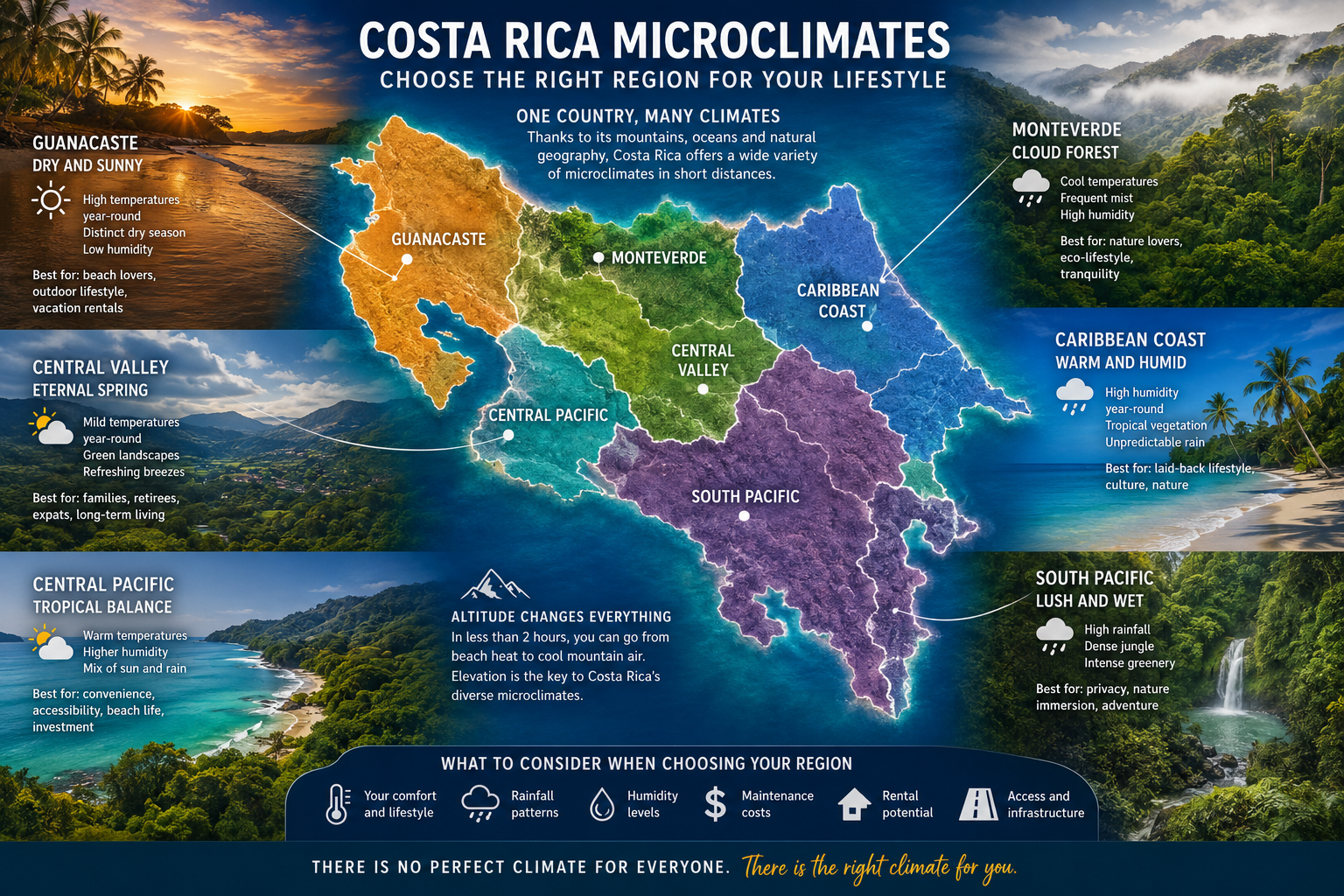
In less than two hours, you can drive from the dry heat of Guanacaste at 95°F to cool mountain air in the Central Valley at 72°F. You can enjoy a sunny morning in Tamarindo and end the day in tropical rain near Dominical or the Caribbean coast.
That is one of the most unique aspects of Costa Rica. Despite its small size, the country offers an incredible diversity of climates created by altitude, mountains, ocean exposure, wind patterns, and dense tropical vegetation.
For buyers, retirees, investors, and expats, this is not a small detail. Climate directly affects:
- your daily comfort;
- energy costs;
- home maintenance;
- humidity levels inside the property;
- landscaping and vegetation growth;
- rental potential;
- long-term lifestyle quality.
Many foreign buyers make the same mistake: choosing a region based only on vacation photos or a short visit during the dry season. But a place that feels perfect for one week may become uncomfortable after several months if you are sensitive to heat, humidity, rain, or isolation.
That is why understanding Costa Rica’s microclimates is essential before buying property or relocating.
Should you choose the dry beaches of Guanacaste? The eternal spring climate of the Central Valley? The lush tropical atmosphere of the South Pacific? The humid Caribbean coast?
The answer depends entirely on your lifestyle, health preferences, investment goals, and tolerance for heat and humidity.
In this guide, we will explore Costa Rica’s main microclimates and help you understand which regions fit different lifestyles and real estate projects.
Costa Rica Is a Country of Microclimates — Not One Tropical Climate
From the outside, many people imagine Costa Rica as one giant tropical paradise with the same weather everywhere. In reality, the country functions almost like several different climates packed into one territory.
Why?
Because Costa Rica combines:
- two coastlines;
- mountain ranges;
- volcanic regions;
- tropical rainforests;
- high-altitude valleys;
- dry coastal plains;
- cloud forests.
The result is dramatic climate variation within short driving distances.
Altitude Changes Everything
Altitude is the number one factor shaping Costa Rica’s microclimates.
At sea level, temperatures can easily reach 90–95°F (32–35°C) for much of the year.
But at elevations of 3,000 to 4,500 feet, temperatures often stay between 70–80°F (21–27°C) year-round.
That is why so many expats fall in love with areas like:
- Atenas;
- Grecia;
- Escazú;
- Santa Ana;
- Heredia;
- San Ramón.
These regions offer cooler temperatures without experiencing true winter.
The Pacific and Caribbean Follow Different Weather Patterns
Costa Rica’s Pacific coast usually has:
- a clear dry season;
- a rainy season;
- months of uninterrupted sunshine;
- lower humidity in certain regions.
The Caribbean coast behaves very differently. Rain patterns are less predictable, and some Caribbean months are actually sunnier while the Pacific side experiences heavy rain.
This surprises many newcomers.
Mountains Create Their Own Climate Systems
Certain regions receive more rain because mountains trap moisture and clouds.
That is why:
- Monteverde feels cool and misty;
- Guanacaste stays dry;
- Dominical remains lush and green;
- the Central Valley enjoys mild temperatures.
When you buy property in Costa Rica, you are not only buying a house.
You are buying a microclimate.
And that microclimate will influence:
- your comfort;
- your utility costs;
- your maintenance budget;
- your daily lifestyle;
- your long-term satisfaction.
There is no universally “best climate” in Costa Rica.
There is only the climate that best matches your personal lifestyle.
Guanacaste: Costa Rica’s Dry and Sunny Microclimate
Guanacaste is probably the best-known region among international buyers, and climate is a major reason why.
This area has one of the driest microclimates in Costa Rica.
Between December and April, many parts of Guanacaste receive almost no rain at all. Skies remain blue for weeks, humidity drops significantly, and outdoor living becomes incredibly enjoyable.
Popular areas include:
- Tamarindo;
- Playa Flamingo;
- Las Catalinas;
- Nosara;
- Playa Hermosa;
- Playas del Coco;
- Samara.
Who Is This Climate Best For?
Typically, people who:
- love beach life;
- enjoy outdoor activities year-round;
- prefer dry heat over humidity;
- want strong vacation rental demand;
- spend lots of time outside.
For investors, the dry season creates excellent rental opportunities. Homes with pools, ocean views, and outdoor entertaining spaces perform especially well.
But Dry Climate Comes With Trade-Offs
This is an important reality many buyers underestimate.
During certain months:
- vegetation becomes very dry;
- dust can become intense;
- temperatures rise significantly;
- water availability becomes critical.
Before buying property in Guanacaste, you should always verify:
- water rights;
- municipal water supply;
- storage systems;
- well capacity;
- seasonal restrictions.
At Crespo Agency, we regularly meet buyers who fall in love with Guanacaste during the dry season but later realize they struggle with the constant heat.
Local microclimates matter tremendously.
A home located on a breezy hillside can feel dramatically cooler than another home just ten minutes away in a low valley.
Orientation, elevation, airflow, and surrounding vegetation all impact daily comfort.
Is It the Best Climate for Vacation Rentals?
In many cases, yes.
Reliable sunshine attracts international tourists throughout the high season, especially from North America and Europe.
However, for full-time living, it is important to ask yourself an honest question:
Do you truly enjoy hot weather all year long?
The Central Valley: Costa Rica’s “Eternal Spring” Climate
Many people arrive in Costa Rica convinced they want to live on the beach. Then they discover the Central Valley and completely change their plans.
Why?
Because the climate is remarkably comfortable.
Thanks to elevation, areas such as:
- Escazú;
- Santa Ana;
- Atenas;
- Grecia;
- Heredia;
- San Ramón;
maintain mild temperatures year-round.
In many homes, air conditioning is unnecessary.
That means:
- lower electricity costs;
- more comfortable sleeping temperatures;
- reduced indoor humidity;
- easier long-term living.
The Biggest Advantage: Daily Convenience
The Central Valley combines:
- pleasant weather;
- modern healthcare;
- international schools;
- shopping;
- restaurants;
- reliable internet;
- airport access.
This makes it extremely attractive for:
- retirees;
- families;
- remote workers;
- entrepreneurs;
- long-term expats.
Not All Central Valley Microclimates Are the Same
This is extremely important.
Atenas tends to be warmer and drier.
Heredia often feels cooler and wetter.
Cartago receives more rain and cooler temperatures.
Escazú offers an excellent balance between sunshine and mild weather.
Even small elevation differences can completely change the living experience.
The Most Common Buyer Mistake
Many buyers only visit during the dry season.
Later, they discover:
- foggy mornings;
- more humidity than expected;
- cooler nights;
- longer rainy periods.
That is why spending real time in different regions before purchasing is so important.
Some people love sleeping under cool mountain air with no AC.
Others need warm tropical heat to feel happy.
Neither choice is wrong.
The key is understanding your personal comfort preferences before investing.
Central and South Pacific: Tropical, Green, and Lush
As you move toward Jacó, Manuel Antonio, Dominical, and Uvita, Costa Rica changes once again.
The jungle becomes denser.
Humidity increases.
Vegetation explodes.
The mountains seem to dive directly into the ocean.
This is the classic tropical Costa Rica many people dream about.
Jacó and Herradura: Tropical Climate With Easy Access
The Central Pacific offers an attractive balance between:
- beach access;
- nightlife;
- restaurants;
- rental demand;
- proximity to San José;
- outdoor activities.
Humidity is higher than in Guanacaste but generally less intense than farther south.
Manuel Antonio: Jungle Meets Ocean
This area attracts nature lovers from around the world.
Living here often means sharing your environment with:
- monkeys;
- toucans;
- tropical birds;
- rainforest vegetation.
But tropical humidity also increases maintenance requirements.
Homes may require more attention regarding:
- paint;
- roofing;
- mold prevention;
- ventilation;
- corrosion protection.
Dominical and Uvita: Much Wetter Microclimates
The South Pacific receives significantly more rainfall.
Some people absolutely love this atmosphere:
- powerful tropical storms;
- vibrant jungle landscapes;
- dramatic scenery;
- total immersion in nature.
Others eventually realize the constant humidity feels overwhelming.
At Crespo Agency, we strongly encourage buyers to visit these regions during different seasons before purchasing property.
A home that feels perfect in February may present serious challenges in October if:
- drainage systems are poor;
- roads become difficult;
- slopes are unstable;
- humidity control is insufficient.
Climate directly impacts long-term maintenance costs and property usability.
Still, for buyers seeking privacy, nature, and spectacular scenery, the South Pacific is unmatched.
The Caribbean and Mountain Regions: Costa Rica’s Most Unique Microclimates
Costa Rica is not only about the Pacific coast.
The Caribbean side offers an entirely different atmosphere.
Puerto Viejo, Cahuita, and Manzanillo are known for their laid-back lifestyle, Afro-Caribbean culture, dense tropical vegetation, and humid climate.
Caribbean Climate: Warm, Humid, and Unpredictable
Here, seasons are less defined.
You may experience:
- intense sunshine;
- sudden rain showers;
- high humidity;
- lush greenery year-round.
Vegetation grows incredibly fast.
That means homes require:
- strong ventilation;
- proper materials;
- regular maintenance;
- humidity management.
Yet many buyers fall in love with the Caribbean precisely because of this raw tropical atmosphere.
Monteverde: The Cloud Forest Microclimate
Monteverde is one of Costa Rica’s most extreme microclimates.
Due to elevation and constant cloud cover, the region experiences:
- cool temperatures;
- frequent mist;
- high humidity;
- dense green landscapes.
Some people immediately love the magical cloud forest atmosphere.
Others realize they need more sunshine and warmth.
San Isidro and Pérez Zeledón: Mountain Living With Balance
These regions are becoming increasingly popular among expats.
Why?
Because they offer:
- cooler temperatures;
- mountain scenery;
- lower population density;
- relatively affordable property options;
- proximity to the South Pacific.
But once again, microclimates vary dramatically depending on:
- elevation;
- wind exposure;
- valley location;
- surrounding mountains.
One property at 2,500 feet may feel perfect.
Another at 4,500 feet may feel too cold or damp for your lifestyle.
That is why climate must be experienced personally.
Photos alone are never enough.
You need to feel:
- the air;
- the humidity;
- the sunlight;
- the temperature;
- the overall atmosphere.
Because in the long run, your quality of life depends far more on climate comfort than on beautiful listing photos.
Conclusion
Costa Rica is one of the few countries where you can truly choose the climate you want to live in.
You can choose:
- Guanacaste’s dry sunshine;
- the Central Valley’s eternal spring;
- the lush tropical South Pacific;
- the humid Caribbean coast;
- cool mountain climates;
- misty cloud forests.
Each region has its own personality, rhythm, and lifestyle.
That is exactly what makes buying property in Costa Rica so unique.
The best region is not necessarily the most famous or most touristic. It is the one where you will genuinely feel comfortable every single day for years to come.
At Crespo Agency, we help clients look beyond photos and trends. We guide them through the reality of each microclimate, including maintenance, comfort, accessibility, investment potential, and long-term livability.
Because in Costa Rica, choosing a home also means choosing a climate.