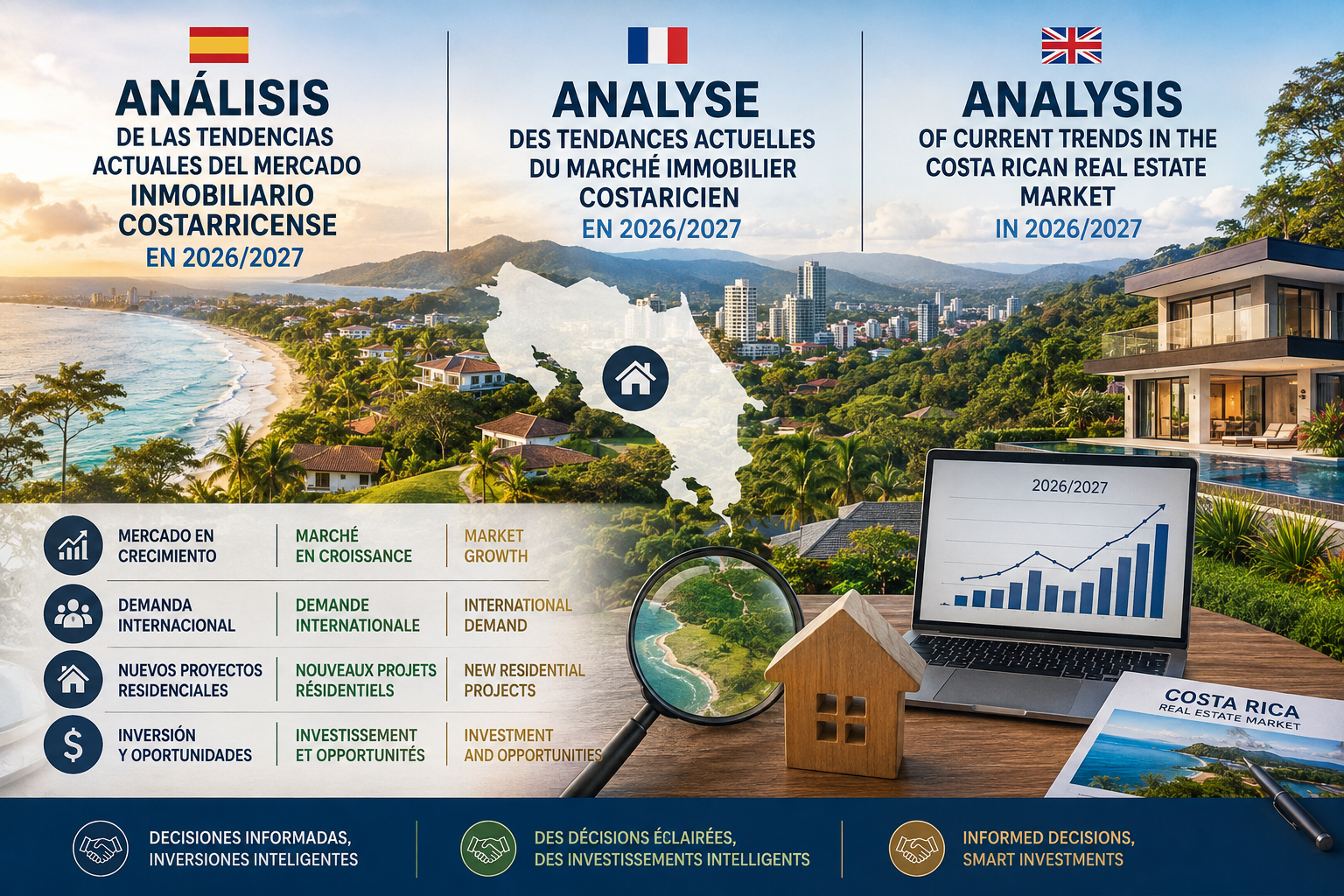
Analysis of Current Costa Rican Real Estate Market Trends in 2026/2027
The Costa Rican real estate market enters the second half of 2026 in a noticeably different position from just three or four years ago. International demand remains present, residential construction is showing strong momentum, and certain areas of the country continue to attract capital. At the same time, buyers have become more demanding. They compare properties more carefully, negotiate more strategically, and pay much closer attention to actual value, infrastructure, and the legal security of each property.
Official data helps put this evolution into perspective. In 2025, 44,591 construction projects were registered in Costa Rica, representing an increase of 7.7% compared with 2024. Even more revealing, the total area constructed reached 4,152,934 m², up 12.7%, while the number of new approved housing units increased by 15.4%.
The momentum continued into 2026. According to the Central Bank of Costa Rica (BCCR), private construction grew by 7.7% year-on-year during the second quarter of 2026, with an especially strong 36.3% increase in residential construction.
That does not mean that “all of Costa Rica is going up,” nor does it mean that every property automatically represents a good investment. The market is becoming increasingly segmented. Guanacaste does not behave like the Central Valley; an ocean-view villa follows different market dynamics from a family home in Grecia; and a property intended for vacation rentals needs to be evaluated differently from a permanent residence.
So what is really happening in the market, and what can buyers reasonably expect in 2027?
To understand the situation, we need to look beyond property listings and examine where construction is taking place, what types of housing are growing, which buyers are driving demand, and which economic factors could influence the market over the coming months.
Residential property is once again driving Costa Rican construction
One of the clearest signals in 2026 comes directly from construction activity.
Data from Costa Rica’s National Institute of Statistics and Census (INEC) had already indicated an acceleration in 2025. That year, 26,212 new housing units were approved, representing 3,498 more units than in 2024 and an increase of 15.4%.
But another figure is even more revealing when trying to understand where the market is heading: the number of housing units classified as apartments and condominiums increased by 46.2%.
This is not simply a matter of building more homes. The type of real estate being developed is changing.
Costa Rica is gradually moving toward a greater supply of:
- gated condominiums with security and shared amenities;
- apartments in urban and suburban areas;
- planned residential communities;
- housing aimed at middle- and higher-income buyers;
- projects combining permanent residence, second-home use, and investment potential.
The BCCR data reinforces this trend. During the second quarter of 2026, private construction increased by 7.7% year-on-year, while residential construction jumped by 36.3%. In contrast, social housing construction declined by approximately 22%.
For an international buyer, this distinction matters.
The current expansion is not evenly distributed across every category of housing. A significant share of the momentum is concentrated precisely in the types of properties that can appeal to expatriates, international professionals, retirees, and second-home buyers.
The size of new homes is changing as well. In 2025, the largest category remained properties measuring 40 to under 70 m², with 13,254 new housing units. However, the 100 to under 150 m² category was among those showing the strongest absolute growth.
What does this tell us?
The market is developing in two directions at the same time: smaller, more efficient units suited to small households or investment purposes, and medium-sized homes aimed at families and buyers with greater purchasing power.
Looking toward 2027, this diversification is likely to remain one of the main drivers of the residential market.
Guanacaste remains strong, but real estate growth is not limited to the coast
When discussing international real estate investment in Costa Rica, Guanacaste naturally occupies a central position. There are structural reasons for this: beaches, a relatively dry climate for much of the year, an international airport, established expatriate communities, and a residential market that has been oriented toward North American and European buyers for years.
Official statistics confirm the province’s importance. However, they also demonstrate why it would be a mistake to analyze Costa Rican real estate exclusively through Guanacaste.
During the first half of 2025, Guanacaste accounted for 18.8% of the country’s total construction area. Alajuela represented 24.9%, while San José accounted for 22.2%. Approximately 66.4% of all construction area during that period was residential.
Full-year 2025 figures subsequently confirmed the importance of Alajuela and San José, which represented 24.2% and 23.5% of the country’s total construction area, respectively.
This gives us a much broader perspective on the 2026/2027 market.
Guanacaste remains one of Costa Rica’s most internationally oriented real estate markets, particularly along coastal corridors where upper-middle and high-end residential properties are prominent. But buyers planning to live permanently in Costa Rica are also considering other parts of the country.
Alajuela, Grecia, Atenas, and selected areas in the western Central Valley appeal to buyers who prioritize climate, services, proximity to Juan Santamaría International Airport, and access to San José.
The Central Pacific has a different profile. Jacó, Herradura, and surrounding areas combine residential demand, tourism, and short-term rentals, while communities farther away appeal to buyers seeking nature, lower density, and larger plots of land.
The Nicoya Peninsula and South Pacific operate according to yet another set of dynamics: more limited availability in certain areas, uneven infrastructure, and properties often positioned around privacy, nature, or unique characteristics.
Even within the same province, two properties located just twenty kilometers apart can belong to completely different real estate markets.
This is why the concept of an “average Costa Rica property price” has limited practical value when making an investment decision.
Official construction statistics are useful for measuring activity, square meters, and new housing supply. They do not, however, constitute a single nationwide index showing the actual transaction price per square meter for every type of Costa Rican property.
To buy wisely in 2026 or 2027, comparisons need to be made locally: same area, comparable property type, similar accessibility, equivalent water availability, comparable construction quality, and a similar legal situation.
Tourism, connectivity, and international buyers continue to support coastal markets
Does tourism still have a meaningful impact on Costa Rican real estate? Yes, but it is important to understand how.
For a property purchased exclusively as a permanent residence, international tourist numbers may seem relatively secondary. In a coastal market dependent on foreign buyers, vacation rentals, restaurants, services, and air connectivity, however, tourism becomes much more relevant.
Guanacaste provides a good example.
During the first three months of 2026 alone, Daniel Oduber Quirós International Airport welcomed 368,413 international tourists. Of these, approximately 254,578 came from the United States and 103,010 from Canada.
In other words, approximately 357,600 visitors from those two markets alone arrived directly in Guanacaste during a single quarter.
This accessibility has indirect consequences for real estate. It makes property-viewing trips easier for prospective buyers, makes second-home ownership more practical, and can improve the viability of certain properties intended for short-term rentals.
The Costa Rican Tourism Institute (ICT) also continues to monitor substantial international air connectivity through both Juan Santamaría and Daniel Oduber airports in 2026, reflecting the importance of both gateways to the country’s international accessibility.
There is, however, an essential distinction: strong tourism does not automatically guarantee strong real estate returns.
A villa can be located in a highly popular tourist destination and still produce disappointing returns if management fees, maintenance, swimming pool costs, landscaping, insurance, and vacancy periods are too high.
The same principle applies to capital appreciation. The reputation of a destination does not justify paying any asking price.
At Crespo Agency, this is one of the points we focus on when assisting international buyers. Before comparing individual properties, we determine whether the primary objective is permanent living, capital preservation, rental income, or a combination of several uses.
We then evaluate each property through that lens.
For a client looking for a permanent residence, for example, proximity to schools, healthcare facilities, supermarkets, and major roads may be considerably more important than being five minutes from the beach.
For another buyer who plans to use the property only a few months each year, proximity to the airport and ease of remote property management may be decisive.
This preliminary work helps prevent one of the most common mistakes: buying an excellent property that is excellent for someone else’s objectives, rather than your own.
Economy, interest rates, and credit: a favorable environment, but not without risks
Real estate never operates in isolation. Interest rates, inflation, access to credit, economic growth, and exchange rates ultimately affect buyers, developers, and property owners.
By the end of July 2026, the Central Bank of Costa Rica was forecasting GDP growth of 3.4% for 2026 and 3.5% for 2027. The Costa Rican economy is therefore expected to continue expanding, although at a more moderate pace than in 2025.
This deserves attention because forecasts changed during the year.
In January 2026, the BCCR had initially projected growth of 3.8% for 2026 and 4.0% for 2027. The July update lowered those projections to 3.4% and 3.5%, respectively.
At this stage, therefore, the official outlook is not pointing toward a recession. Instead, it suggests continued positive economic growth at a more moderate pace and within an uncertain international environment.
A significant change has also taken place in monetary policy.
On July 23, 2026, the BCCR reduced its monetary policy rate by 25 basis points to 3.00% per year.
That does not mean a mortgage will automatically be available at 3%. The monetary policy rate serves as a benchmark for broader financial conditions; it is not the final interest rate paid by a borrower.
Nevertheless, a less restrictive monetary policy environment can gradually support financing conditions and economic activity.
The Central Bank also estimates that credit to the private sector could grow by an annual average of approximately 6.2% during 2026-2027, in both local and foreign currency, although some slowdown in foreign-currency credit is expected.
International buyers need to add two more variables to the equation.
The first is the exchange rate. If your income or savings are denominated in US dollars, euros, or Canadian dollars, changes in their value against the Costa Rican colón can significantly affect living expenses, construction costs, property maintenance, and your overall purchasing power.
The second is financing.
Many international buyers choose to purchase with cash because obtaining local bank financing can involve additional documentation, financial records, guarantees, and approval requirements.
If financing is involved, compare the total cost of borrowing rather than focusing solely on the advertised interest rate.
For 2027, a prudent strategy is to build a conservative financial scenario. Your investment should continue to make sense even if expenses increase, exchange rates move against you, or rental occupancy is lower than initially projected.
Real estate investment is becoming more selective
Over recent years, some Costa Rican markets experienced enough demand for very different types of properties to appreciate at the same time.
As a market matures, asset selection becomes increasingly important.
One indication can be found in the composition of private construction. While residential activity grew by 36.3% year-on-year in the second quarter of 2026, non-residential construction declined by 11.6%, mainly because of weaker activity involving offices and industrial buildings.
The market is therefore not accelerating uniformly. Capital is being directed toward particular uses and specific housing segments.
Costa Rica also continues to operate in an environment characterized by international investment. Preliminary figures reported by PROCOMER using BCCR information showed foreign direct investment of approximately US$4.585 billion during the first quarter of 2026, although one particularly large corporate transaction had a substantial effect on that figure.
For residential buyers, however, the most useful question is not simply: “Is foreign capital continuing to enter Costa Rica?”
A better question is: “Does this particular property have the characteristics that buyers will still value five or ten years from now?”
That brings much more practical criteria into the analysis:
- properly verified title and registry status;
- legal access to the property;
- availability and legal status of water supply;
- electricity and adequate internet connectivity;
- drainage and land conditions during the rainy season;
- construction quality and overall maintenance;
- year-round accessibility;
- proximity to essential services;
- competing property supply in the surrounding area;
- potential ease of resale.
These checks become even more important in coastal areas.
An exceptional ocean view can certainly justify a premium. But difficult road access, high maintenance expenses, or a complicated legal situation can substantially reduce a property’s liquidity when the time comes to sell.
There is another factor buyers should watch carefully: new supply.
The 46.2% increase in apartments and condominiums recorded in 2025 shows how quickly residential supply is developing. In some areas, that gives buyers more choice. In others, it may create additional competition among properties offered for rent or resale.
In 2027, the distinction between “buying in a growing area” and “buying a strong property within that growing area” is likely to become increasingly important.
What can we expect from Costa Rica’s real estate market in 2027?
Nobody can know today exactly what price a house in Tamarindo, Santa Ana, Nosara, or Grecia will sell for eighteen months from now.
A responsible forecast therefore should not promise a specific percentage of appreciation. Instead, it should identify the forces already shaping the market and determine which of them are likely to remain relevant in 2027.
Based on the official data available as of August 2026, five trends appear particularly significant.
First, residential construction is likely to remain an important component of overall activity. The 36.3% year-on-year increase recorded during the second quarter of 2026 shows that projects are moving forward and capital continues to flow toward private residential construction.
Second, condominiums and organized residential communities are likely to continue expanding. The 46.2% increase in apartments and condominiums recorded in 2025 is large enough to indicate a broader structural shift in housing supply.
Third, Guanacaste is likely to retain a privileged position among international buyers, supported by international air connectivity and particularly strong demand from US and Canadian markets. At the same time, the Central Valley and selected areas of Alajuela should continue attracting permanent residents who prioritize infrastructure and services.
Fourth, buyers are likely to become increasingly price-sensitive. The BCCR continues to forecast economic expansion in 2027, but its growth expectations were revised downward during 2026. The overall scenario remains constructive, but it calls for greater selectivity.
Fifth, the underlying quality of the asset is likely to matter more than the reputation of the location alone. Properties with good access, functional infrastructure, clear legal status, sound construction, and realistic pricing should generally be better positioned to preserve liquidity than assets purchased mainly on speculative expectations.
This is why we do not recommend approaching 2027 with a binary question such as: “Will the Costa Rican real estate market go up or down?”
Costa Rica consists of many different micro-markets, and they will not all react in the same way.
For a buyer, a much more useful question is: Which property would still have strong fundamentals even if the overall market became less enthusiastic?
That is precisely the type of property worth looking for.
Buying in Costa Rica in 2026/2027: less speculation, more analysis
Official indicators describe a real estate market that remains active: 44,591 construction projects registered in 2025, a 12.7% increase in total construction area, 26,212 approved new housing units, strong growth in apartments and condominiums, and private residential construction still rising by 36.3% year-on-year in the second quarter of 2026.
The broader economic environment is not currently pointing toward a general contraction either. The Central Bank expects the Costa Rican economy to grow by 3.4% in 2026 and 3.5% in 2027.
But these figures do not justify buying just any property.
The 2026/2027 market increasingly rewards careful selection: micro-location, purchase price, legal security, infrastructure, construction quality, maintenance costs, and future demand.
If you are considering relocating to Costa Rica, purchasing a second home, or making a real estate investment, our role at Crespo Agency is precisely to connect these national trends with what is actually happening on the ground.
We analyze your objectives, identify areas that match your priorities, select suitable properties, organize in-person or virtual viewings, and connect you with the appropriate local professionals for legal and administrative due diligence.
Because choosing Costa Rica may ultimately be the easy part.
Choosing where to buy, what to buy, and at what price is where the real work begins.



Join The Discussion